|
|
There is controversy about this new doll created by American Girl.
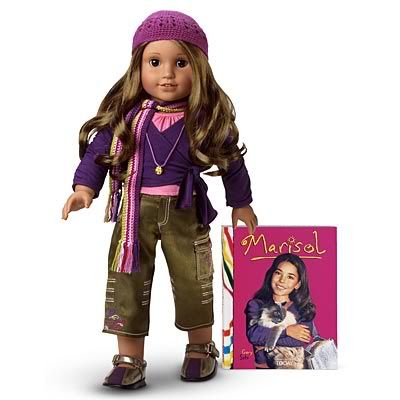
The controversy should be about how the doll looks nothing like the girl on the cover of the book.
Anyway, here's what all the fuss is about:
CHICAGO U-S Representative Luis Gutierrez says he has invited the president of the American Girl company that created a new Mexican-American doll to visit a Chicago neighborhood that feels snubbed by the doll.
The doll is called Marisol Luna and her story says she lives in Chicago's Pilsen neighborhood. But the story also says her mother moves the family to suburban Des Plaines because Pilsen is too dangerous.
In a statement, the American Girl company said people shouldn't base their opinion of the story based on one sentence. A spokeswoman says the danger reference is to street traffic.
In his invitation to the company president, the Chicago Democrat said that Pilsen has parks and playgrounds and the story demeans the character of the neighborhood.
American Girl says its president plans to speak with Gutierrez.
...and more here:
American Girl doll move upsets some
By Ames Boykin Daily Herald Staff Writer
Posted Wednesday, February 02, 2005
(...)
Young Marisol Luna, however, seems to have sashayed her knit-skull-cap-wearing self into a controversy - something her American Girl creators never intended for the doll they designed to empower young girls.
In a book that accompanies the doll, Marisol's mother tells her they must move to Des Plaines from Chicago's Pilsen neighborhood because it's no place for a young girl.
"It was dangerous, and there was no place for me to play," the book says.
(...)
Des Plaines has its own vibrant Hispanic community. According to the 2000 Census, 14 percent of Des Plaines' 58,720 residents are Hispanic. Its chamber of commerce recently started a committee catering to businesses owned or run by Hispanics, or ones with Hispanic employees.
In contrast to the West Side Pilsen neighborhood, which had three murders last year, Police Chief James Prandini said Des Plaines hasn't had a murder in the past three years. Gang activity is limited to graffiti in Des Plaines, he said.
"They picked our town as a safe place to live," Arredia said. "I don't see anything wrong with that."
Leaders in Pilsen, however, do. They see the story as a slight to their neighborhood, which is home to the Mexican Fine Arts Center Museum.
Claudia G. Martinez, executive director of the Pilsen Little Village Information Center, spent Tuesday speaking to residents who were upset. While families do choose to leave Pilsen, it's more likely because it's more affordable to live in the suburbs, she said. Homes in Pilsen are fetching a half-million dollars, while families can own a home in the suburbs for half that amount, Martinez said.
"Just as any community, you have problems," she said. "But it's like a family. When somebody says something about your brother, you don't like it."
At the American Girl headquarters, they are shocked at the negative reaction to the doll, which is selling for $84. Spokeswoman Julie Parks said Marisol at one point proclaims Pilsen the "best place in the world." Her family moves to Des Plaines to have a home with a yard where she can play.
In the story, Marisol's mother also tells her they are moving to be closer to her job, so she can spend more time with the family, Parks said.
Hector Marino, coordinator of computer and technical services for Des Plaines Public Library, is familiar with the story of Marisol because he bought the doll for his 9-year-old daughter. To him, it makes sense Marisol would move from the city because her family wants a home and access to parking. He appreciates having a Hispanic doll for his daughter to play with, saying it's encouraging to see more diversity.
I don't know, I guess I can see why people that live in the neighborhood would be mad, but it's just a doll for crying out loud. Just be glad the doll isn't really offensive, you know, like come with a velvet painting of the Last Supper, have 20-inch diameter hoop earings, maroon lip liner, and is dressed in a wife beater and a pair of Dickies.
CJ at 2/02/2005
Comments:
Actually, you're right. At least the doll wasn't offensive looking with the maroon lip liner. What upsets me personally is that the city is gentrifying forcing Latino/African-American families along with gangs to the suburbs.
Actually, the low key racism in the book is part of why the city is gentrifying, pushing minority communities to the suburbs in order to present a "safe" environment.
A Response to Marisol
I, too, as the mother of a two Mexican children growing up in Chicago, have a problem with Soto's story line in "Marisol".
What I see as the biggest problem is that the story is dumbed down; rather than teaching children about the gentrification that is stealing the neighborhoods that once belonged to the poor, and other social issues faced by those living in the inner city, Soto waters it down to Marisol's playing in traffic, and chooses an equally poor solution, moving away. Children who are readers and thinkers can understand deeper concepts than traffic safety; and if they need help understanding, that is what parents and teachers are for.
What Soto missed (and I am surprised at him, having read other books of his) is that Pilsen, rich community that it is, is one that should be fought for and not run away from. Yes, Marisol loves to dance and follows her dream, but it is a trite and over-simplified storyline. She could have just as easily followed her dream in Pilsen, and been a fighter for her culture and neighborhood as well.
I took my daughter to American Girl Place in Chicago this past week and we purchased the Marisol doll. I wouldn't tell her she couldn't have the doll; she had earned the opportunity to finally choose one of these dolls, and that was the one she chose. I did, however, tell her that moving to the suburbs is not the answer for everyone. It is certainly not the answer if one wishes to keep their culture alive. As for me, I don't want to raise my children in a homogenized world. I want them to learn their culture and to fight for it. I have seen too many Mexican and Puerto Rican neighborhoods in Chicago be lost, and with that also goes the culture.
Pilsen right now is struggling with gentrification. The Marisol story does not help with that struggle, but rather, just feeds the myth that the Mexicans need to quietly disappear, and let the gentrifiers take over the neighborhood.
Something I noticed at American Girl Place was that it was patronized by nearly all white people. There was a very small percentage of any people of color represented, at least on the day we were there. (The persons of color I did notice were largely those working the cash registers.) It is my conjecture that the clientele of American Girl, by and large, lives in a homogenized, fairly safe, and yes, white, world. Soto missed his chance as a Latino to claim his culture's depth and uniqueness, and their right to stay in their inner-city neighborhood. He took the easy way out. He missed his chance to give the girls who read the American Girl books the opportunity to imagine living in a Mexican neighborhood and staying there -- not running away from it in fear.
As someone who grew up loving "A Tree Grows in Brooklyn", I can clearly say that the reason I loved the book was because of Francie and her will to survive and pursue her dreams, against the odds in a slum in Brooklyn -- not in a suburb.
As for me and my daughter and Marisol, we are going to the Mexican Fine Arts Museum in Pilsen this weekend. We are taking Marisol right back to her neighborhood -- where she belongs.
Back to Tortilla Sandwich
3 comments
-------------------------------------------------------------------------------------
|
|

